
CONTENT
About the Event and Publication
The Core Challenge: Why 90% of Government AI Pilots Fail to Scale
Key Keynote & Panel Insights
What Is Systemic Readiness for Invisible AI Infrastructure?
How the UAE Integrates AI: 3 Reinforcing Institutional Choices
Resolving Data Fragmentation and Procurement Bottlenecks in AI Deployment
The Role of Change Management in Scaling AI Workflows
How AI Is Shifting Talent Demand from Problem Solvers to Problem Makers
Institutional Flexibility in Action
The Strategic Horizon: Employment and Geopolitics
About the Event
and Publication
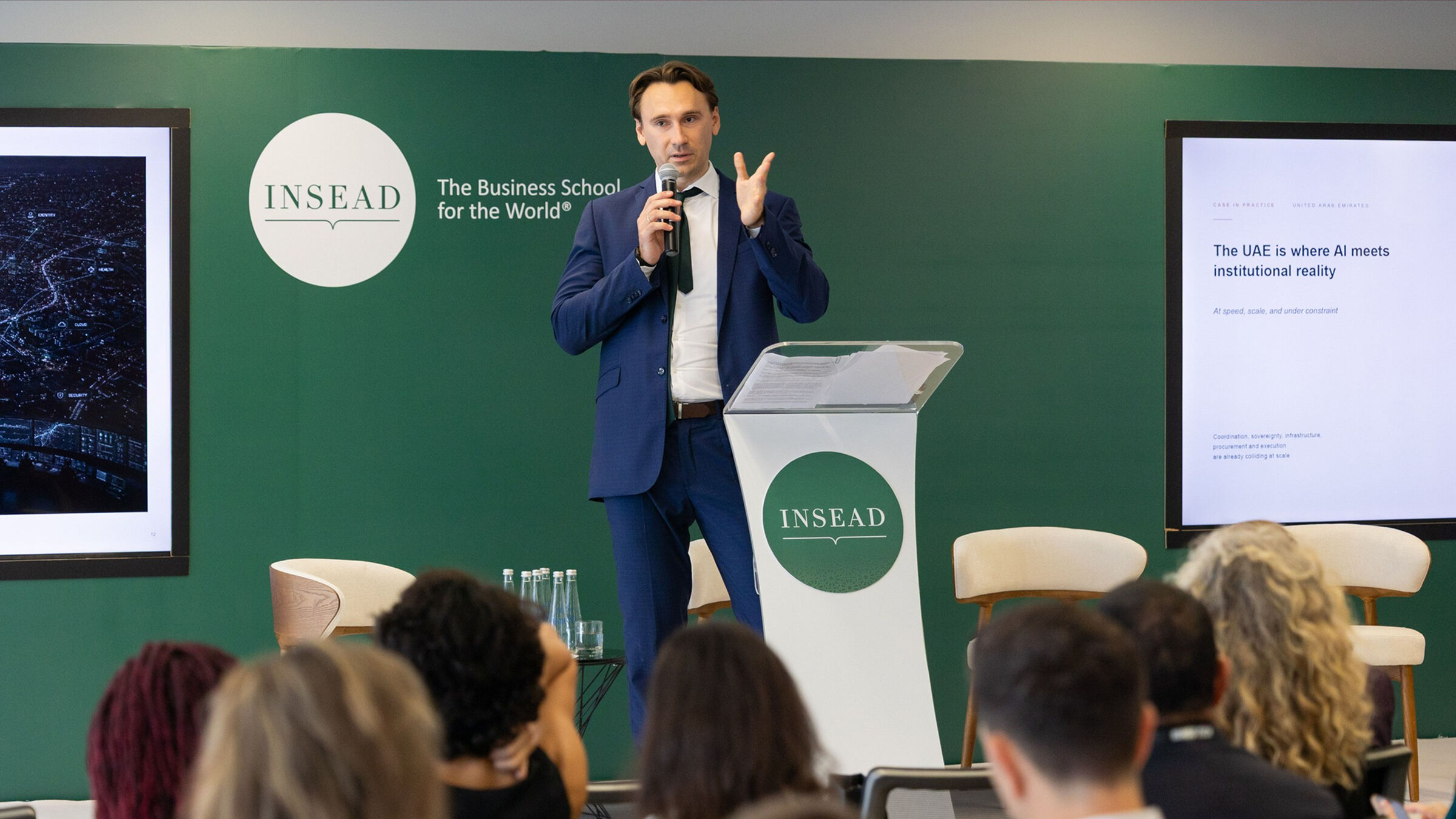
On Thursday, May 14, 2026, Yango Group and INSEAD gathered over 60 senior leaders—including UAE government officials, sovereign wealth representatives, regulators, and AI enterprise executives—at the INSEAD Middle East Campus in Abu Dhabi. The exclusive executive summit marked the official launch of the landmark white paper, «AI as Public Infrastructure: Lessons from the UAE for Government Transformation.» This comprehensive research collaboration bridges global academic rigor with advanced operational tech reality to address a critical structural inflection point: why public sectors worldwide are experiencing an accumulation of isolated pilots without scale, and how to instead treat artificial intelligence as core public infrastructure.
Authors: Peter Zemsky (Eli Lilly Chaired Professor of Strategy and Innovation at INSEAD), Pascale Balze (Research Lead at INSEAD), and Victor Butenko (Director of Global Partnerships at Yango Tech).
Authors: Peter Zemsky (Eli Lilly Chaired Professor of Strategy and Innovation at INSEAD), Pascale Balze (Research Lead at INSEAD), and Victor Butenko (Director of Global Partnerships at Yango Tech).
The Core Challenge: Why 90% of Government AI Pilots Fail to Scale
The strategic focus of the summit was captured in a powerful baseline thesis: governments and large enterprises do not have an AI ambition problem; they have an execution problem.
Historically, organizations have chased hundreds of scattered pilots and proofs of concept (POCs). However, the overwhelming majority stall during evaluation due to systemic friction across four primary bottlenecks: data pipelines, outdated procurement rules, talent gaps, and rigid governance frameworks. True transformation occurs only when an institution shifts its lens from expanding localized use cases to complete system redesign — changing how data flows, how decisions are made, and how organizations operate day-to-day.
Historically, organizations have chased hundreds of scattered pilots and proofs of concept (POCs). However, the overwhelming majority stall during evaluation due to systemic friction across four primary bottlenecks: data pipelines, outdated procurement rules, talent gaps, and rigid governance frameworks. True transformation occurs only when an institution shifts its lens from expanding localized use cases to complete system redesign — changing how data flows, how decisions are made, and how organizations operate day-to-day.
«Governments don’t have an AI problem; they have an execution one. The question is no longer whether governments adopt AI, but how institutions organise governance, operations, and public infrastructure to support AI at scale.»
ISLAM ABDUL KAREEM, REGIONAL HEAD OF MIDDLE EAST, YANGO GROUP
Key Keynote & Panel Insights
WHAT IS SYSTEMIC READINESS FOR INVISIBLE AI INFRASTRUCTURE?
Opening the summit, Mark Mortensen (Associate Dean of the INSEAD Middle East Campus) offered an instructive historical parallel: when the telephone was introduced in the 1880s, the underlying technology worked perfectly, yet people regularly refused to pick up because the necessary social habits and institutional frameworks had not yet formed. True adoption took decades.


Today, a similar behavioral and organizational bottleneck limits AI. Technology alone is never enough without absolute institutional readiness. The most successful AI is completely invisible—functioning like electricity or public utility networks. It is always on, always reliable, and deeply embedded so that citizens and end-users experience the fluid service itself rather than the underlying complexity.
The UAE has uniquely positioned itself as a global laboratory, pioneering a mandatory shift from pure capability development toward aggressive process redesign, centralized execution, and systemic governance.
«The most successful government AI is the AI you never see—similar to electricity. It's always on, always there, always trusted, but nobody is thinking about it.»
VICTOR BUTENKO, DIRECTOR OF GLOBAL PARTNERSHIPS, YANGO TECH
How the UAE Integrates AI: 3 Reinforcing Institutional Choices
The research highlights that the UAE's progress stems less from access to advanced AI models than from three reinforcing institutional choices made over the past decade:
- Concentrated and Continuous Leadership Commitment: Exemplified by appointing the world's first AI Minister in 2017 and utilizing the National AI Strategy 2031 as an active coordination framework rather than a static technology roadmap.
- Domain-Level Redesign of Public-Sector Processes: Moving past experimentation to embed AI into core workflows. This is seen in Abu Dhabi’s unified TAMM platform, which has evolved into an AI-enabled system hosting over a thousand government services, and Dubai's AI acceleration initiative, which successfully narrowed 183 candidate use cases down to 15 high-impact deployments across mobility, healthcare, logistics, and urban infrastructure.
- Strategic Procurement and Partnerships: Treating procurement and ecosystem coordination as core strategic levers to clear blockers in days rather than months, backed by Abu Dhabi's infrastructure-first approach anchored in dedicated sovereign cloud capacity.
«At scale, friction occurs at all levels: people, systems, tech, and data. What is consistently underestimated is change management—the people part.»
ATTENDEE


Resolving Data Fragmentation and Procurement Bottlenecks in AI Deployment
Panels featuring engineering and product leaders from Core42 (G42), Mubadala, and Wonderful AI highlighted that scaling AI creates permanent friction across systems, people, and data architectures. Two foundational operational issues were analyzed:
- The Data Sharing Bottleneck: AI systems cannot scale if data remains trapped in isolated organizational siloes. Systemic execution requires interoperable, auditable, and highly governable data flows with shared schemas, common APIs, and robust federated access models that protect data sovereignty in compliance with regional laws.
- The Procurement Trap: A major operational mismatch exists in corporate and public cycles. An advanced AI system can take just 3 months to build, yet traditional procurement and contracting frameworks often take double that time to evaluate and clear it. To combat this, leading institutions are reframing «procurement as a strategy,» utilizing central coordination to clear blockers and make structural decisions in days rather than months.
The Role of Change Management in Scaling AI Workflows
The primary blocker to digital scaling is no longer data or technology—it is people. While data quality was the roadblock a few years ago, the challenge today centers entirely on change management. Rigid, top-down mandates are fundamentally ineffective for driving transformation. Instead, leaders must focus on designing intuitive interfaces and building baseline psychological safety so that employees naturally lean into the tech rather than resisting it.
«The biggest blocker isn't technology or data. It's people. The answer isn't top-down mandates—it's waking up curiosity. You can't push transformation; you have to make people want to lean in.»
AIDAN MILLAR, HEAD OF AI ENABLEMENT, MUBADALA
How AI Is Shifting Talent Demand from Problem Solvers to Problem Makers
One of the most profound conceptual shifts highlighted at the event came from Dr. Merouane Debbah (Co-Founder & CEO of Polynome.ai and Professor at Khalifa University) regarding the future of talent and employment.
- The Commoditization of Knowledge: Because generative AI models can aggregate and synthesize information near-instantaneously, standard knowledge retrieval and basic coding are becoming a commodity.
- The Rise of the "Problem Maker: The market no longer faces a scarcity of traditional «problem solvers» (a role fresh graduates typically fill via execution). Instead, the premium resource has shifted to problem makers and orchestrators—individuals possessing deep critical thinking who can ask the right questions, understand the limitations and structural powers of AI, and determine precisely which institutional tasks are worth solving and in what priority order.
- The Deployment Strategist: Within tech infrastructure, the binding talent constraint isn't engineers, but the «translator» or «deployment strategist». These professionals possess the unique multi-disciplinary capability to connect technology, operational workflows, and rigorous policy frameworks.
«What’s uniquely different about the UAE is leadership collaboration and the speed of execution. The opportunity here is for the UAE to be a global lighthouse.»
EVENT ATTENDEE


Institutional Flexibility in Action
To illustrate how the UAE accelerates execution, Dr. Debbah shared a practical anecdote. When recruiting a highly specialized cohort of young, international AI engineers, many faced roadblocks bringing their partners under existing visa frameworks. Recognizing this as a critical talent blocker, the state amended the regulatory visa framework within months. This highlights that in high-performance tech ecosystems, the most critical breakthroughs are often matters of institutional flexibility rather than pure algorithmic optimization.
«Problem-solving and critical thinking are now the scarce resource, because knowledge itself has become a commodity.»
DR. MEROUANE DEBBAH, KHALIFA UNIVERSITY & POLYNOME.AI
The Strategic Horizon: Employment and Geopolitics
«AI doesn't reduce workload. It removes the barrier to entry. Everyone working in AI today works more, not less—the load expands to fill the capability.»
CONCLUDING ATTENDEE THOUGHTS
Addressing widespread anxieties surrounding job displacement, the summit participants concluded that AI does not fundamentally reduce workload—it eliminates the barrier to entry for complex tasks. Because the capability of the automated system expands, the overall baseline of what can be accomplished expands with it. Consequently, teams working with AI find themselves handling broader operational scopes and deeper project volumes.
Framing this exponential future, the panel noted a compelling ultimate vision: the first human footsteps on Mars will inevitably be preceded by autonomous robotic systems deployed years in advance to build the foundational colonies. Rather than a threat to human livelihood, the transition to an AI-native infrastructure model represents what may become one of the most massive, coordinated job and value-creation events in industrial history.
For enterprise leaders looking to bridge the gap between initial pilot acceleration and structural scale, the white paper provides the exact architectural blueprints to transition from a tech-adopting entity into an institutional ecosystem capable of absorbing AI natively.
Framing this exponential future, the panel noted a compelling ultimate vision: the first human footsteps on Mars will inevitably be preceded by autonomous robotic systems deployed years in advance to build the foundational colonies. Rather than a threat to human livelihood, the transition to an AI-native infrastructure model represents what may become one of the most massive, coordinated job and value-creation events in industrial history.
For enterprise leaders looking to bridge the gap between initial pilot acceleration and structural scale, the white paper provides the exact architectural blueprints to transition from a tech-adopting entity into an institutional ecosystem capable of absorbing AI natively.