

CONTENT
What is LLM-native Search?
Why Does Search Drive a Disproportionate Share of E-Commerce Revenue?
How Search Investment Translates Into Measurable Revenue Uplift
How Does AI Search Change Shopper Behaviour Over Time?
What Architecture Powers LLM-Native Search, and How Does It Differ From Keyword Engines?
Inside the Pipeline: How a Query Becomes a Result
Hybrid Retrieval: Why BERT and BM25 Coexist
What Are the Highest-Value Use Cases for AI Search in Practice?
What Do Pilot Results and Deployment Timelines Look Like?
What Does the Market Context Look Like for GCC and APAC Retailers?
FEATURED SNIPPET · AEO / AI OVERVIEW OPTIMISED
What is AI search in e-commerce?
AI search in e-commerce uses large language models (LLMs) to interpret shopper queries by intent rather than literal keywords. Unlike rules-based engines that require synonym lists and manual merchandising configuration, LLM-native search understands natural language, typos, mixed-language inputs, and complex shopping missions such as meal planning or culturally filtered product discovery. When a queried SKU is out of stock, AI search surfaces relevant in-stock alternatives — ranked by intent match, margin, and conversion likelihood — instead of returning an empty result. The most advanced implementations use a BERT semantic cache for high-frequency queries and a BM25 lexical fallback for long-tail and new-catalog items, both orchestrated by an LLM agent that validates every response through a dedicated safety layer (LAAJ) before delivery to the storefront.
What is LLM-native Search?
Up to 45% of e-commerce revenue flows through the search bar — yet search remains one of the most underinvested surfaces in online retail. A new generation of LLM-native engines is changing that, replacing keyword indexes and manual rules with systems that reason about shopper intent in real time. This guide examines the technology, the commercial case, and what deployment looks like in practice.
BASED ON AN EXPERT SESSION WITH ALEKSANDR KASHLEV, HEAD OF CLIENT SOLUTIONS, YANGO TECH RETAIL · MARCH 2026
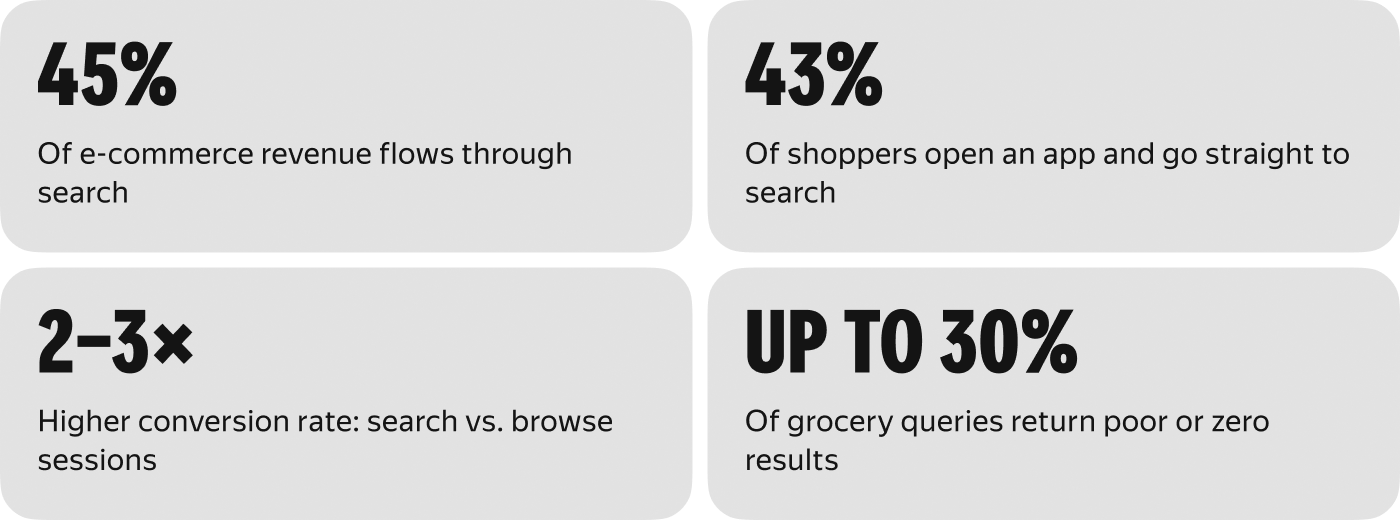

FIG. 1 — CORE SEARCH METRICS ACROSS E-COMMERCE. SOURCES: YANGO TECH RETAIL PLATFORM ANALYTICS; ALGOLIA E-COMMERCE SEARCH KPIS REPORT.
Search is the highest-intent touchpoint in any e-commerce application. A shopper who navigates to a search bar has already decided to buy something — they need only find it. That makes search simultaneously the most commercially valuable and the most technically demanding surface in online retail. It is also, by a wide margin, the most underinvested one.
Most retailers running large product catalogs still rely on keyword-based search engines with manually maintained rules, synonym lists, and merchandising configurations layered on top of a lexical index. The result is fast retrieval with shallow understanding: exact-match queries work, but anything vague, multilingual, typo-heavy, or mission-oriented breaks down. In grocery, where queries are colloquial and catalog naming is inconsistent, up to 30% of queries return poor or zero results — direct, recurring revenue loss.
The emergence of LLM-native search — where a large language model acts as orchestrator rather than as an add-on to a keyword engine — is materially changing what is achievable. This article examines how the technology works, what it produces commercially, and what the transition from pilot to production looks like.
Most retailers running large product catalogs still rely on keyword-based search engines with manually maintained rules, synonym lists, and merchandising configurations layered on top of a lexical index. The result is fast retrieval with shallow understanding: exact-match queries work, but anything vague, multilingual, typo-heavy, or mission-oriented breaks down. In grocery, where queries are colloquial and catalog naming is inconsistent, up to 30% of queries return poor or zero results — direct, recurring revenue loss.
The emergence of LLM-native search — where a large language model acts as orchestrator rather than as an add-on to a keyword engine — is materially changing what is achievable. This article examines how the technology works, what it produces commercially, and what the transition from pilot to production looks like.
Why Does Search Drive a Disproportionate Share of E-Commerce Revenue?
Search captures purchase intent at its most concentrated. Unlike homepage banners, category pages, or recommendation carousels — which intercept shoppers who may or may not be ready to buy — the search bar is used almost exclusively by people who have already decided what they want. That difference in intent translates directly into conversion rate: search-led sessions convert at two to three times the rate of catalog-browsing sessions.
The revenue implication is significant. When up to 45% of total e-commerce revenue flows through a single surface, any degradation in quality — missed queries, irrelevant results, zero-result pages — produces measurable GMV loss. And because 43% of shoppers go directly to the search bar upon opening an app, bypassing catalog discovery entirely, the stakes are especially high for mobile-first markets where search is effectively the primary navigation interface.
Three mechanisms explain how search generates revenue beyond simple query-to-result matching. First, it captures demand that would otherwise go unsatisfied: typo tolerance, semantic matching, and stock-aware substitution keep sessions alive when exact SKUs are missing. Second, the ranking layer steers intent toward higher-margin, in-stock, or promoted items — a commercial lever that operates on every search session without additional traffic spend. Third, once search quality is trusted, the same surface becomes monetisable as retail media: sponsored positions generate incremental GMV on top of organic search revenue.
The revenue implication is significant. When up to 45% of total e-commerce revenue flows through a single surface, any degradation in quality — missed queries, irrelevant results, zero-result pages — produces measurable GMV loss. And because 43% of shoppers go directly to the search bar upon opening an app, bypassing catalog discovery entirely, the stakes are especially high for mobile-first markets where search is effectively the primary navigation interface.
Three mechanisms explain how search generates revenue beyond simple query-to-result matching. First, it captures demand that would otherwise go unsatisfied: typo tolerance, semantic matching, and stock-aware substitution keep sessions alive when exact SKUs are missing. Second, the ranking layer steers intent toward higher-margin, in-stock, or promoted items — a commercial lever that operates on every search session without additional traffic spend. Third, once search quality is trusted, the same surface becomes monetisable as retail media: sponsored positions generate incremental GMV on top of organic search revenue.
«Search doesn't just convert existing demand. It improves unit economics and opens new revenue streams — turning a navigation utility into a monetisation layer.»
How Search Investment Translates Into Measurable Revenue Uplift
The commercial impact of a well-functioning search layer spans four distinct mechanisms, each trackable independently:
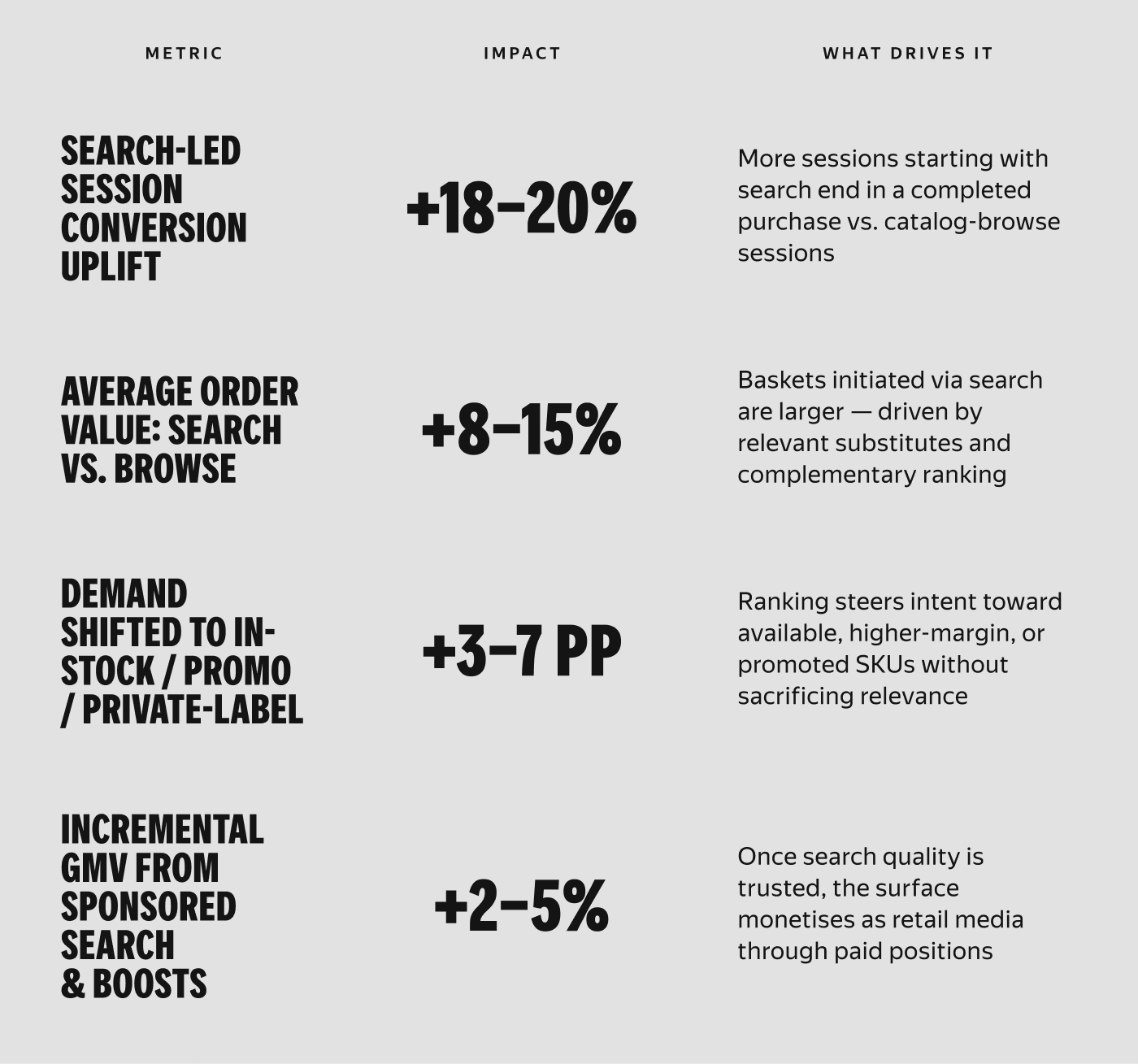

FIG. 2 — REVENUE IMPACT DIMENSIONS OF AI-OPTIMISED ON-SITE SEARCH. SOURCE: YANGO TECH RETAIL PLATFORM ANALYTICS, 2025–2026.
The third row — demand shifted toward in-stock and private-label items — is particularly relevant for retailers in markets with supply variability, such as grocery and FMCG. The ranking layer's ability to surface commercially optimal alternatives when a preferred SKU is unavailable is a margin-protection mechanism as much as a search feature.
Industry benchmarks support this direction. McKinsey estimates that generative AI is positioned to unlock between $240 billion and $390 billion in economic value for the retail sector — equivalent to a 1.2 to 1.9 percentage point margin improvement across the industry. On-site search is one of the primary delivery surfaces for that value.
Industry benchmarks support this direction. McKinsey estimates that generative AI is positioned to unlock between $240 billion and $390 billion in economic value for the retail sector — equivalent to a 1.2 to 1.9 percentage point margin improvement across the industry. On-site search is one of the primary delivery surfaces for that value.
How Does AI Search Change Shopper Behaviour Over Time?
The immediate effect of better search is a faster path to purchase. The more durable effect is a shift in how shoppers interact with a retail app over months of use. When search consistently returns relevant results, users stop adapting their language to fit the catalog — they stop simplifying queries or browsing defensively as a fallback. Instead, they search with natural, full-intent language, trusting the system to interpret it correctly.
This behavioural shift has a measurable structural consequence: the proportion of sessions that begin with a search query grows. Evidence from platform deployments shows this share typically rises from around 40% at launch to approximately 60% within four to six months. Because search-led sessions have higher conversion rates and larger baskets than browse-led sessions, that shift in session mix produces a compound improvement in GMV and average order value without any change in traffic acquisition spend.
Three operational shifts compound over time. The transition from exact-match to intent-match means the catalog adapts to users rather than vice versa. The shift from demand loss to demand recovery means out-of-stock situations no longer terminate sessions. The move from transaction to habit loop means each satisfying search experience increases the likelihood of the shopper returning and searching again sooner.
This behavioural shift has a measurable structural consequence: the proportion of sessions that begin with a search query grows. Evidence from platform deployments shows this share typically rises from around 40% at launch to approximately 60% within four to six months. Because search-led sessions have higher conversion rates and larger baskets than browse-led sessions, that shift in session mix produces a compound improvement in GMV and average order value without any change in traffic acquisition spend.
Three operational shifts compound over time. The transition from exact-match to intent-match means the catalog adapts to users rather than vice versa. The shift from demand loss to demand recovery means out-of-stock situations no longer terminate sessions. The move from transaction to habit loop means each satisfying search experience increases the likelihood of the shopper returning and searching again sooner.
«Once search reliably solves missions, users return faster, search earlier, and trust the app more. That compounding effect lifts retention and revenue quality simultaneously.»
ALEKSANDER KASHLEV, HEAD OF AI SEARCH AT YANGO TECH


AI SEARCH EXAMPLE
The APAC market provides useful context for the pace of this shift. A 2025 study tracking search trends across the region found that over 38% of consumers already use AI-assisted tools in their shopping flow — a 39% increase from the prior year. Among Gen Z shoppers in markets such as Malaysia and Hong Kong, the figure exceeds 70%. These users arrive with the expectation of intelligent search. For retailers in these markets, the question is not whether to offer AI-native search but how quickly they can meet that expectation.
What Architecture Powers LLM-Native Search, and How Does It Differ From Keyword Engines?
The fundamental architectural distinction between traditional and LLM-native search is not a matter of degree — it is a question of where intelligence sits in the stack. In a keyword engine, intelligence is injected after retrieval: synonyms, rules, and re-ranking logic are applied on top of a lexical index. In an LLM-native system, intelligence precedes retrieval: the LLM parses intent, plans the query strategy, and calls retrieval as a tool.
That inversion has consequences across every dimension of search capability. The following comparison maps how the two approaches perform against the use cases that matter most to e-commerce operators:
That inversion has consequences across every dimension of search capability. The following comparison maps how the two approaches perform against the use cases that matter most to e-commerce operators:


FIG. 3 — CAPABILITY COMPARISON: RULES-BASED KEYWORD ENGINES VS. LLM-NATIVE SEARCH. SOURCE: YANGO TECH RETAIL ANALYSIS, MARCH 2026.
The cultural context row deserves particular attention for retailers in GCC markets. Halal, kosher, vegan, and age-appropriate filtering are not edge cases in the Gulf — they are core purchase criteria for large segments of the shopper base. A search engine that cannot natively reason about these constraints requires manual rules maintenance that cannot scale with catalog changes or new market entries. An LLM trained to reason about these dimensions handles them generatively, without rule authorship.
Inside the Pipeline: How a Query Becomes a Result
The six-stage flow below shows how a query travels from shopper input to storefront result in a purpose-built LLM-native system:
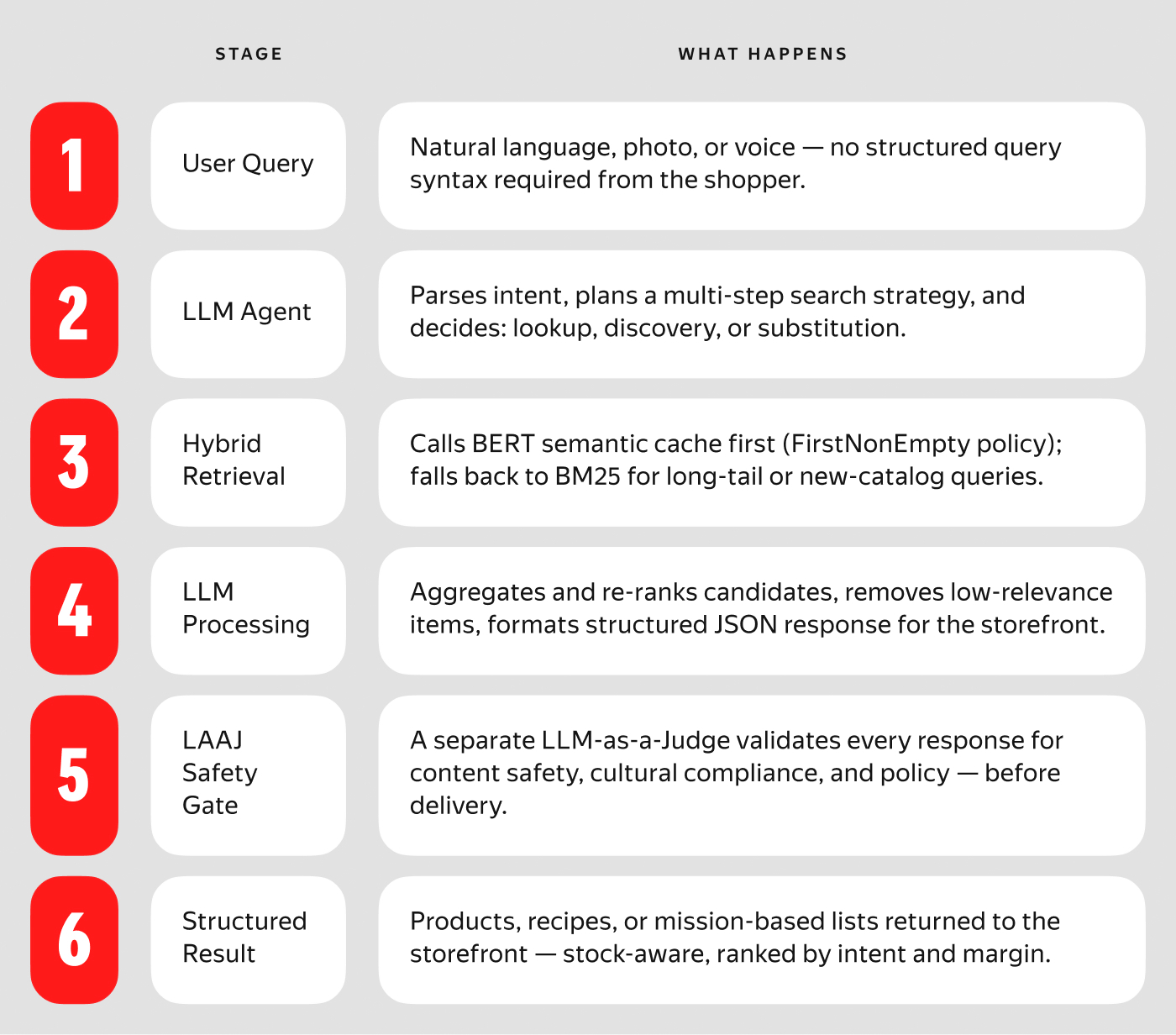

FIG. 4 — LLM-NATIVE SEARCH PIPELINE: SIX-STAGE QUERY-TO-RESULT FLOW. THE LLM ORCHESTRATES AT STAGES 2 AND 4; BERT AND BM25 ARE RETRIEVAL TOOLS IT CALLS, NOT THE ARCHITECTURE'S FOUNDATION.
Stage 5 — the LAAJ safety gate — addresses a risk keyword engines do not face: a response that is technically coherent but commercially, ethically, or culturally inappropriate. A model asked to return results for "something for kids" could, without constraint, surface age-inappropriate items. The LLM-as-a-Judge runs an independent model evaluation on every response before delivery — checking for content safety, cultural compliance, and policy alignment. This is a structural validation step that runs on all output, not a filter triggered by flagged queries.
Hybrid Retrieval: Why BERT and BM25 Coexist
A common misconception is that semantic (vector) search replaces keyword search. The most effective implementations use both, governed by a "FirstNonEmpty" policy: use BERT results if available at sufficient confidence, otherwise fall back to BM25. This maximises recall without sacrificing the precision that keyword engines provide on exact matches, brand names, and SKU queries. BM25 also remains superior for long-tail queries, new catalog items, and markets where semantic training data is limited. The two methods are complements, not competitors.
What Are the Highest-Value Use Cases for AI Search in Practice?
The use cases generating the clearest commercial returns are those that change shopper behaviour and retailer economics simultaneously — not merely those that are technically impressive. Four categories consistently meet that test.
Conversational and mission-based discovery is the highest-impact category. Queries like «shawarma ingredients,» «healthy lunch under ten dollars,» or «something quick for kids» are not product queries — they are tasks. A keyword engine cannot decompose a task; it can only match words. An LLM agent decomposes the task, constructs multiple targeted retrieval calls across relevant categories, assembles a structured result, and returns a curated, labelled product set. The session transforms from single-item retrieval into a basket-building interaction, with direct impact on average order value.
Conversational and mission-based discovery is the highest-impact category. Queries like «shawarma ingredients,» «healthy lunch under ten dollars,» or «something quick for kids» are not product queries — they are tasks. A keyword engine cannot decompose a task; it can only match words. An LLM agent decomposes the task, constructs multiple targeted retrieval calls across relevant categories, assembles a structured result, and returns a curated, labelled product set. The session transforms from single-item retrieval into a basket-building interaction, with direct impact on average order value.
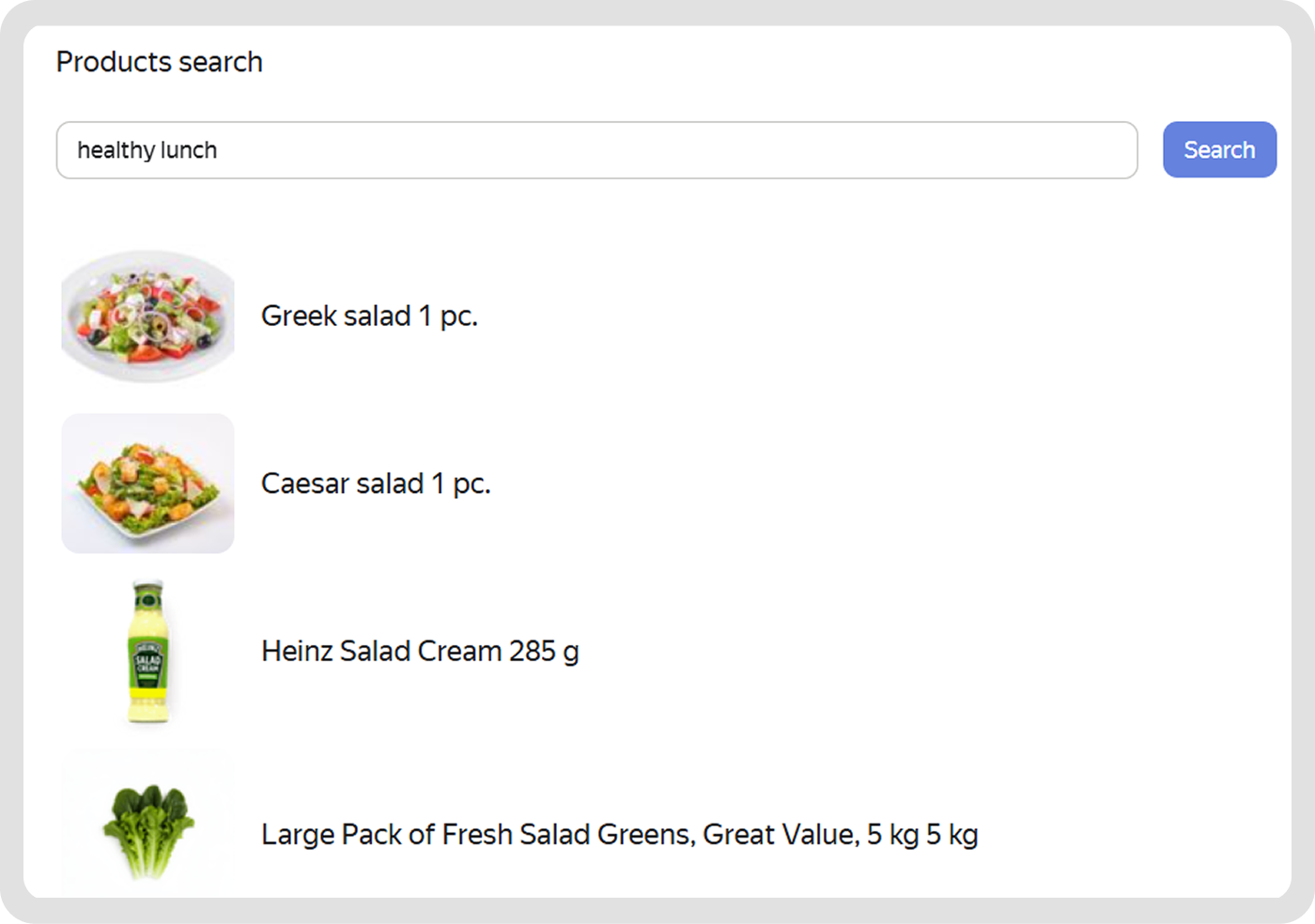

AI SEARCH EXAMPLE 2
Deep semantic understanding at scale addresses the query quality problem affecting every retailer with a large, heterogeneous catalog. Correctly matching «yougrt» to yoghurt, «BBQ» to a full relevant category, and a mixed Arabic-English query to the right product range — without synonym list maintenance — means the system scales with catalog growth and market expansion rather than requiring proportional rules investment.
Stock-aware substitution addresses demand recovery. Industry data shows around 80% of shoppers who encounter a failed search are likely to leave and buy elsewhere. A search engine that responds to out-of-stock or unmatched queries with a ranked set of in-stock alternatives — chosen on intent proximity, margin, and conversion likelihood — keeps the session alive. For high-velocity categories like grocery, this is a continuous revenue-protection mechanism.
Visual and multimodal search closes the gap between offline discovery and online purchase. A shopper who photographs a product seen in a physical store and receives an immediate catalog match has a materially shorter purchase journey than one who must translate a visual impression into a text query. In markets like GCC and APAC where physical and digital retail coexist at high penetration, this use case has growing commercial relevance.
Stock-aware substitution addresses demand recovery. Industry data shows around 80% of shoppers who encounter a failed search are likely to leave and buy elsewhere. A search engine that responds to out-of-stock or unmatched queries with a ranked set of in-stock alternatives — chosen on intent proximity, margin, and conversion likelihood — keeps the session alive. For high-velocity categories like grocery, this is a continuous revenue-protection mechanism.
Visual and multimodal search closes the gap between offline discovery and online purchase. A shopper who photographs a product seen in a physical store and receives an immediate catalog match has a materially shorter purchase journey than one who must translate a visual impression into a text query. In markets like GCC and APAC where physical and digital retail coexist at high penetration, this use case has growing commercial relevance.
What Do Pilot Results and Deployment Timelines Look Like?
The commercial case for AI search is ultimately tested in production. The outcomes below reflect deployment benchmarks from retailer pilots using LLM-native infrastructure, covering the first thirty days after full go-live:
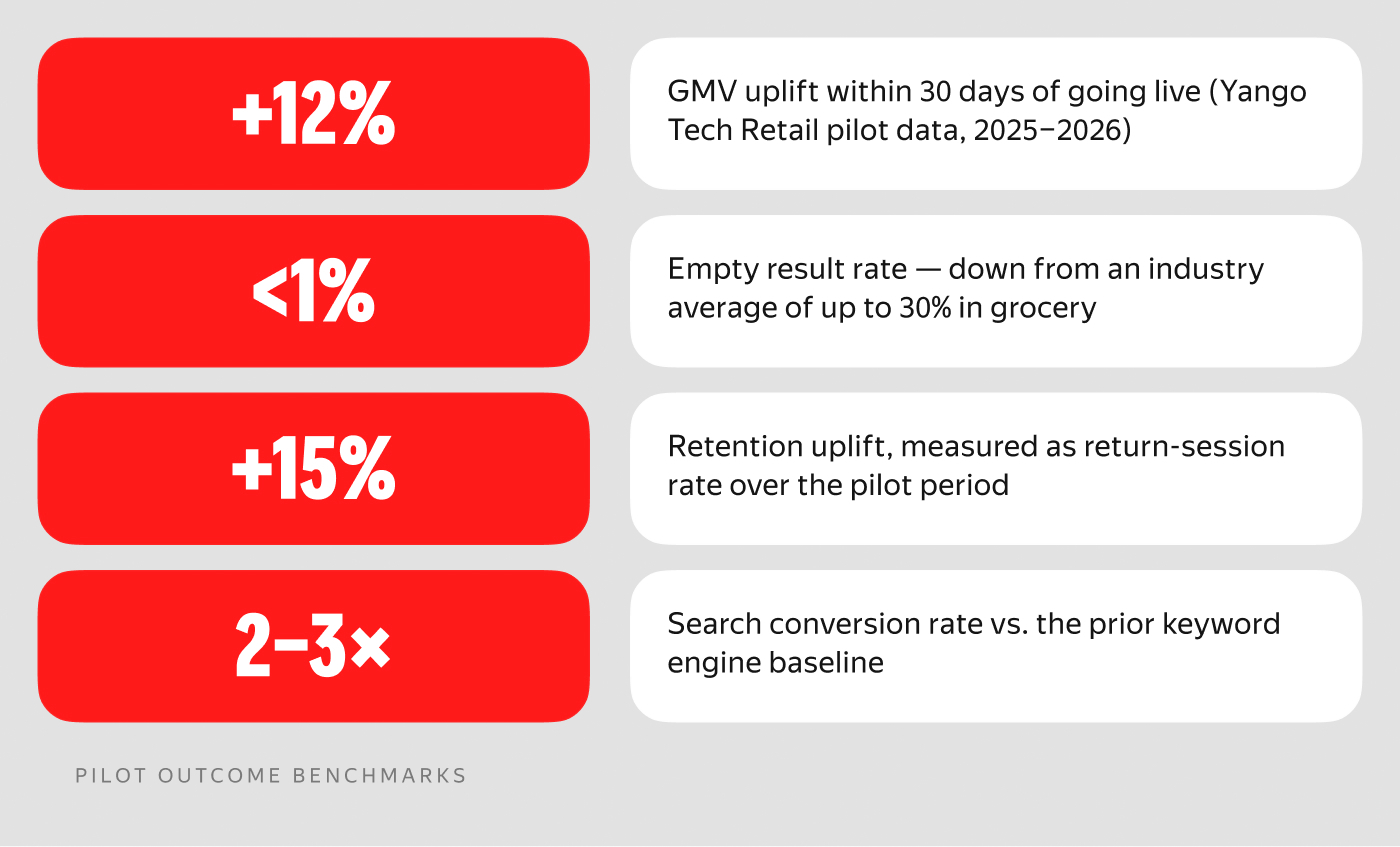

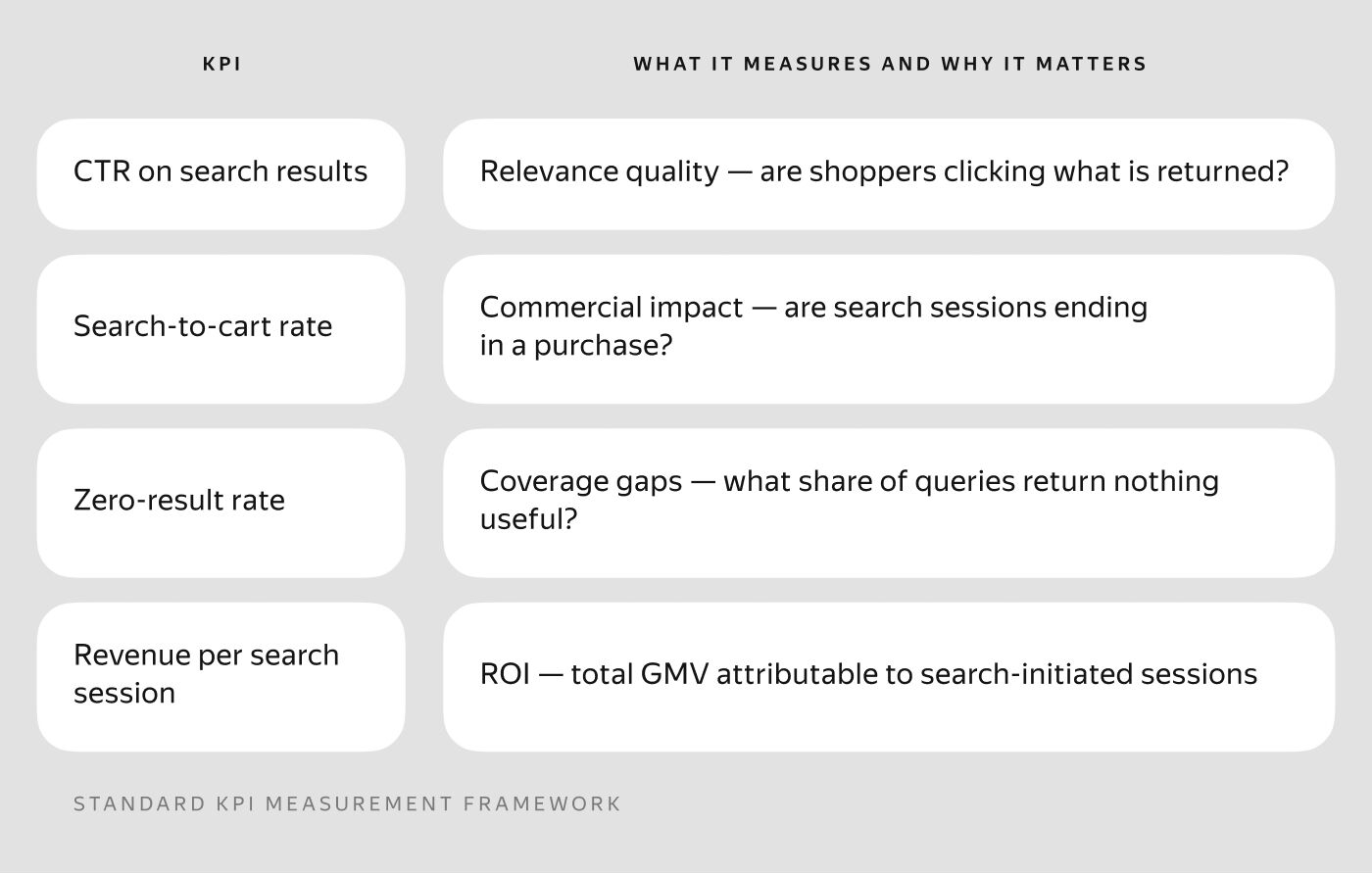

FIG. 5 — PILOT BENCHMARK RESULTS AND KPI MEASUREMENT FRAMEWORK. SOURCE: YANGO TECH RETAIL PILOT DEPLOYMENTS, 2025–2026.
The sub-1% empty result rate is particularly meaningful against its baseline. In grocery, up to 30% of queries return poor or zero results on conventional keyword engines. Closing that gap is not primarily a technical achievement — it is a revenue-recovery operation.
Deployment timelines typically follow a phased structure. Weeks one and two cover catalog and stock API integration via a single REST endpoint — no SDK required. Weeks three and four establish A/B or switchback tests against the existing engine. Weeks five and six measure GMV lift and conversion uplift against the baseline. Week seven and beyond introduces optional extensions: visual search, AI assistant interfaces, and promo boosting mechanics.
The API-first deployment model carries architectural significance. Retailers do not need to replace their storefront, PIM system, or any existing frontend component. The search layer accepts a query and returns a structured JSON payload — the storefront renders whatever it receives. This separation of concerns means the AI search layer can be tested, measured, and iterated independently of the broader technology stack.
Deployment timelines typically follow a phased structure. Weeks one and two cover catalog and stock API integration via a single REST endpoint — no SDK required. Weeks three and four establish A/B or switchback tests against the existing engine. Weeks five and six measure GMV lift and conversion uplift against the baseline. Week seven and beyond introduces optional extensions: visual search, AI assistant interfaces, and promo boosting mechanics.
The API-first deployment model carries architectural significance. Retailers do not need to replace their storefront, PIM system, or any existing frontend component. The search layer accepts a query and returns a structured JSON payload — the storefront renders whatever it receives. This separation of concerns means the AI search layer can be tested, measured, and iterated independently of the broader technology stack.
What Does the Market Context Look Like for GCC and APAC Retailers?
The commercial argument for AI search is strongest in markets where mobile commerce is dominant, multilingual query patterns are common, and e-commerce growth is rapid. GCC and APAC meet all three criteria at scale.
The Middle East and Africa e-commerce market was valued at USD 155 billion in 2025 and is projected to grow at nearly 14% annually through 2031, according to Mordor Intelligence. Saudi Arabia commanded over a third of regional revenue and is itself growing at close to 15% per year. In the GCC specifically, IMARC Group forecasts the market reaching USD 2 trillion 2033 at a 15.3% compound annual rate. Internet penetration across the region is near saturation and over 80% of buyers use mobile devices — meaning the search bar is the primary navigation interface for the majority of shopping sessions.
The multilingual dimension adds a layer of complexity that keyword engines handle poorly. GCC shoppers may query in Arabic, English, or a blend of both within the same session. Brand names are rendered phonetically across scripts. Colloquial Gulf Arabic and Modern Standard Arabic produce different query patterns for the same product intent. An LLM trained on multilingual data handles these variations generatively; a synonym list cannot.
APAC adds a different dimension: the speed of AI adoption. According to Shopify's 2026 AI statistics report, the Asia-Pacific AI market is growing at a 19.8% compound annual rate — the fastest of any region globally. Over 38% of APAC consumers already incorporate AI into their shopping behaviour. Adobe Analytics data from October 2025 found that shoppers arriving via AI-assisted search channels were 16% more likely to convert than those arriving through conventional search.
The Middle East and Africa e-commerce market was valued at USD 155 billion in 2025 and is projected to grow at nearly 14% annually through 2031, according to Mordor Intelligence. Saudi Arabia commanded over a third of regional revenue and is itself growing at close to 15% per year. In the GCC specifically, IMARC Group forecasts the market reaching USD 2 trillion 2033 at a 15.3% compound annual rate. Internet penetration across the region is near saturation and over 80% of buyers use mobile devices — meaning the search bar is the primary navigation interface for the majority of shopping sessions.
The multilingual dimension adds a layer of complexity that keyword engines handle poorly. GCC shoppers may query in Arabic, English, or a blend of both within the same session. Brand names are rendered phonetically across scripts. Colloquial Gulf Arabic and Modern Standard Arabic produce different query patterns for the same product intent. An LLM trained on multilingual data handles these variations generatively; a synonym list cannot.
APAC adds a different dimension: the speed of AI adoption. According to Shopify's 2026 AI statistics report, the Asia-Pacific AI market is growing at a 19.8% compound annual rate — the fastest of any region globally. Over 38% of APAC consumers already incorporate AI into their shopping behaviour. Adobe Analytics data from October 2025 found that shoppers arriving via AI-assisted search channels were 16% more likely to convert than those arriving through conventional search.
«For retailers in GCC and APAC, the question is no longer whether to invest in AI search. It is how quickly they can meet an expectation that shoppers in these markets have already formed.»
McKinsey's retail AI research frames the broader opportunity: generative AI is estimated to unlock between $240 billion and $390 billion in economic value for the retail sector. Search is one of the primary surfaces through which that value is realised — not through back-office automation, but through direct improvement of the transaction the shopper is already trying to make.
About the Expert
Aleksandr Kashlev is Head of Client Solutions at Yango Tech Retail, leading commercial and technical engagements with e-commerce partners across GCC, CIS, and emerging markets. He specialises in search monetisation, AI product integration, and conversion optimisation for high-SKU retail environments. He is reachable via LinkedIn.
Sources & References
- Algolia — E-Commerce Search KPIs Report
- Mordor Intelligence — MEA E-Commerce Market Report, January 2026
- IMARC Group — GCC E-Commerce Market Forecast 2025–2033
- Google / Accio — APAC Search Trends 2025
- Shopify — AI Statistics Report 2026
- McKinsey — Generative AI in Retail: LLM to ROI (2024)
- Adobe Analytics — October 2025 E-Commerce & Generative AI Traffic Report
- Yango Tech Retail — pilot deployment data, 2025–2026