
CONTENT
What Is the AI Hype Cycle, and Where Are We Right Now?
Why Do 80% of AI Projects Fail? The Five Root Causes
What Actually Is Generative AI? Moving Beyond the Robot Aesthetic
Do You Need a Custom LLM? Almost Certainly Not — As The First Choice
What an AI Agent Actually Is (and Is Not)
Where Should Your Organization Actually Invest?
The KPI Trap: Why “How Many Processes Has AI Transformed?” Is the Wrong Question
Five Things C-Level Executives Should Do Differently
The Real Competitive Advantage: Competence, Not Compute
The promise is familiar. You read the analyst reports, your competitors are rolling out chatbots and «AI-powered» dashboards, the board starts asking questions, and within weeks there’s a pilot budget and a vice-president who owns the initiative. Then, six months later, the pilot quietly disappears. Nobody talks about it. The vendor is replaced, or the project is «paused for reprioritization.»
According to a 2024 RAND Corporation study, this story is not the exception — it is the rule. More than 80% of enterprise AI projects fail to deliver lasting value, and they do so at twice the rate of non-AI projects. The reasons are rarely about the model being too weak or the compute too expensive. They are almost always organizational and strategic.
Alexander Merkushev has spent over eight years on the implementation side of that equation — leading AI deployments across industries at YangoTech, the enterprise-technology arm of Yango.
According to a 2024 RAND Corporation study, this story is not the exception — it is the rule. More than 80% of enterprise AI projects fail to deliver lasting value, and they do so at twice the rate of non-AI projects. The reasons are rarely about the model being too weak or the compute too expensive. They are almost always organizational and strategic.
Alexander Merkushev has spent over eight years on the implementation side of that equation — leading AI deployments across industries at YangoTech, the enterprise-technology arm of Yango.
What Is the AI Hype Cycle, and Where Are We Right Now?
The Gartner Hype Cycle describes how emerging technologies move from an innovation trigger through a peak of inflated expectations, a trough of disillusionment, and eventually a slope of enlightenment toward a productivity plateau. In 2025, generative AI and foundation models are sliding toward the trough, while AI agents sit squarely at the peak of inflated expectations — which is exactly where caution is most warranted.
The pattern is not new. Merkushev traces it through every major technology wave: the wheel became useful only when it became a cart; the combustion engine only mattered once Henry Ford industrialized the automobile. The same dynamic played out with cloud computing, which took thirty years from invention to mainstream adoption, and with Big Data, which attracted billions in investment before most organizations admitted they still could not extract value from it.
The pattern is not new. Merkushev traces it through every major technology wave: the wheel became useful only when it became a cart; the combustion engine only mattered once Henry Ford industrialized the automobile. The same dynamic played out with cloud computing, which took thirty years from invention to mainstream adoption, and with Big Data, which attracted billions in investment before most organizations admitted they still could not extract value from it.


SOURCE: GARTNER HYPE CYCLE FOR ARTIFICIAL INTELLIGENCE, 2025 | HIGHLIGHTED COLUMN INDICATES WHERE GENERATIVE AI CURRENTLY STANDS.
«Right now everyone is saying: LLM didn’t work out, but if we deploy an AI agent, then we’ll just fly into space. AI agents are exactly at the peak of inflated expectations — the most dangerous position on the curve»
ALEXANDER MERKUSHEV, HEAD OF AI PROJECTS, YANGO TECH
One of 2 common strategies when deploying AI is to start with back-office functions such as document processing, internal tooling, and code generation. When Merkushev was asked whether caution about client-facing AI is warranted, the answer was unambiguous.
«This choice is exactly the right strategy — starting inside the back-office. I see many companies whose core business is customer service, and they immediately want to deploy something inherently non-deterministic into their most critical workflow, without the team, the competence, or even a proper technical specification.»
ALEXANDER MERKUSHEV
Why Do 80% of AI Projects Fail? The Five Root Causes
The RAND Corporation’s 2024 analysis of AI project failures identifies five structural causes that explain why most enterprise AI investments stall before reaching production. Merkushev’s field experience maps directly onto each of them.


Each of these causes, Merkushev argues, has the same solution: accumulated expert experience. «A person with real implementation experience already understands how to decompose a business problem into a concrete ML task — classification, time-series forecasting, or something specific. Stakeholders say ‘analyze this,’ ‘optimize that,’ ‘make it more efficient.’ These are metaphors. The model needs precise numbers and precise processes.»
The talent gap is not a local problem — it is a global one. The Global AI Index 2025 ranks the UAE 20th overall, with relatively strong scores in government strategy and research, but a notable weakness in ‘ the metric that measures qualified people capable of implementing AI solutions. Only the United States and China score strongly on this dimension. «All around the world, there is a lot of hype,» Merkushev observed, «but very few people with real deployment experience.»
That shortage is reflected in implementation barriers. A 2023 Gather survey of 114 enterprise organizations found that technical implementation (cited by 28% of respondents as one of their top three challenges), operating costs (26%), and finding the right specialists (26%) were the dominant obstacles — far ahead of cultural resistance (12%) or lack of management support (13%). The chasm between idea and production-ready product is primarily a human and organizational chasm, not a technology chasm.
The talent gap is not a local problem — it is a global one. The Global AI Index 2025 ranks the UAE 20th overall, with relatively strong scores in government strategy and research, but a notable weakness in ‘ the metric that measures qualified people capable of implementing AI solutions. Only the United States and China score strongly on this dimension. «All around the world, there is a lot of hype,» Merkushev observed, «but very few people with real deployment experience.»
That shortage is reflected in implementation barriers. A 2023 Gather survey of 114 enterprise organizations found that technical implementation (cited by 28% of respondents as one of their top three challenges), operating costs (26%), and finding the right specialists (26%) were the dominant obstacles — far ahead of cultural resistance (12%) or lack of management support (13%). The chasm between idea and production-ready product is primarily a human and organizational chasm, not a technology chasm.


What Actually Is Generative AI? Moving Beyond the Robot Aesthetic
Generative AI is not an anthropomorphic robot on a black background. At its core, it is a neural network that receives a sequence of numbers as input and outputs the most statistically probable next number. Applied to language, this becomes a large language model (LLM): given a text prompt and a body of training data spanning effectively all of written human knowledge, the model predicts the most probable continuation.
The distinction between ML, GenAI, and agentic AI matters practically, not just theoretically. Classical machine learning — sales forecasting, credit scoring, demand prediction — is well understood, delivers proven ROI, and is being overlooked in the rush toward generative models. GenAI opens a different set of capabilities. Agentic AI layers autonomy, memory, planning, and external integrations on top.
The distinction between ML, GenAI, and agentic AI matters practically, not just theoretically. Classical machine learning — sales forecasting, credit scoring, demand prediction — is well understood, delivers proven ROI, and is being overlooked in the rush toward generative models. GenAI opens a different set of capabilities. Agentic AI layers autonomy, memory, planning, and external integrations on top.
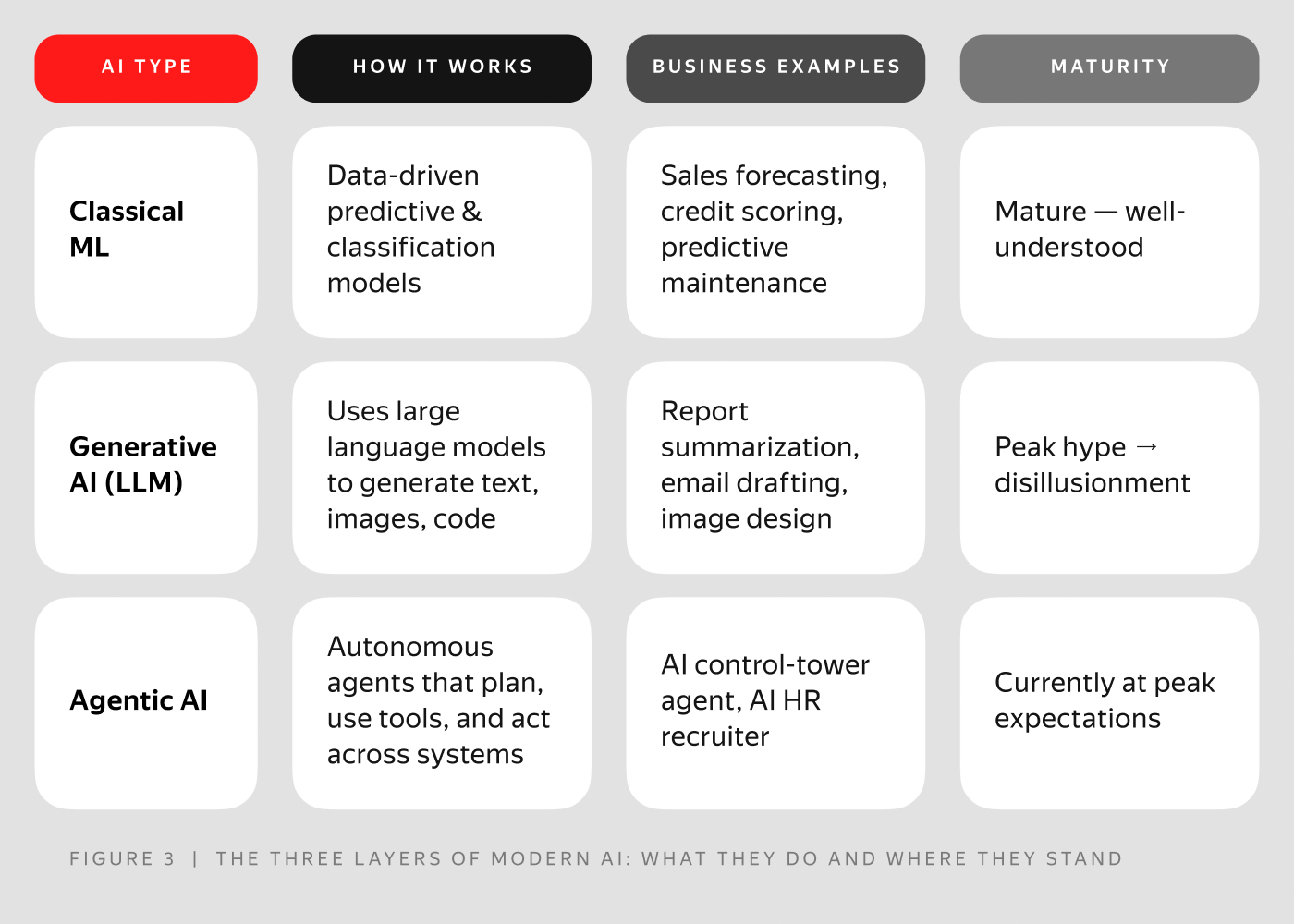

BASED ON PRESENTATION BY ALEXANDER MERKUSHEV, YANDEX TECH, MARCH 2026.
Merkushev used a striking analogy to explain how GenAI models actually learn: «The training method is deceptively simple. Words in a sentence are masked. The neural network’s job is to predict the missing words. It does this billions of times across all available text. That is how your brain works right now reading this sentence — filling in context from what surrounds the gap.»
This framing has a direct implication for enterprise use: the model itself is not the differentiating factor. «Compare Stanford, MIT, and top global university graduates,» Merkushev said. «They are roughly equally useless if you do not give them the right instructions, the right knowledge base, and the right tools for the job. Models are converging in performance. The competitive advantage lies in how you deploy them.»
This framing has a direct implication for enterprise use: the model itself is not the differentiating factor. «Compare Stanford, MIT, and top global university graduates,» Merkushev said. «They are roughly equally useless if you do not give them the right instructions, the right knowledge base, and the right tools for the job. Models are converging in performance. The competitive advantage lies in how you deploy them.»
Do You Need a Custom LLM? Almost Certainly Not — As The First Choice
One of the most persistent and expensive misconceptions in enterprise AI is the belief that meaningful deployment requires training a proprietary large language model on internal data. It does not. Three techniques cover the vast majority of real-world business use cases, and they do not require touching the underlying model at all.
Prompt engineering — writing precise system instructions and context — is the entry point. It is low-cost, fast, and often underestimated. «Every product, whether Anthropic's Claude or ChatGPT, has a system prompt,» Merkushev noted. «Grok’s system prompt recently leaked online. These constraints and roles are not magic — they are instructions. Your AI employee needs instructions just like any other employee would.»
Retrieval-Augmented Generation (RAG) is the next layer. Rather than attempting to bake proprietary knowledge into the model through training, RAG gives the model access to a curated knowledge base at inference time. The analogy Merkushev offered is instructive: «A junior lawyer does not memorize every statute. She searches, reads the relevant passage, and formulates a conclusion. A Stanford law graduate without access to the library performs worse than a regional college graduate who has the right book in hand.» The quality of the knowledge base — its structure, its indexing, its retrieval engine — matters far more than the choice of model.
Fine-tuning, the third technique, adds domain-specific experience to the model. It is appropriate in fewer cases than most organizations assume — primarily when the model needs to internalize a domain’s style, terminology, or decision-making pattern that cannot be captured in a prompt or retrieved from a document.
Prompt engineering — writing precise system instructions and context — is the entry point. It is low-cost, fast, and often underestimated. «Every product, whether Anthropic's Claude or ChatGPT, has a system prompt,» Merkushev noted. «Grok’s system prompt recently leaked online. These constraints and roles are not magic — they are instructions. Your AI employee needs instructions just like any other employee would.»
Retrieval-Augmented Generation (RAG) is the next layer. Rather than attempting to bake proprietary knowledge into the model through training, RAG gives the model access to a curated knowledge base at inference time. The analogy Merkushev offered is instructive: «A junior lawyer does not memorize every statute. She searches, reads the relevant passage, and formulates a conclusion. A Stanford law graduate without access to the library performs worse than a regional college graduate who has the right book in hand.» The quality of the knowledge base — its structure, its indexing, its retrieval engine — matters far more than the choice of model.
Fine-tuning, the third technique, adds domain-specific experience to the model. It is appropriate in fewer cases than most organizations assume — primarily when the model needs to internalize a domain’s style, terminology, or decision-making pattern that cannot be captured in a prompt or retrieved from a document.


What an AI Agent Actually Is (and Is Not)
An AI agent is not a chatbot with a system prompt. It is not an RPA script with an LLM bolted on. It is not a RAG pipeline. An agentic AI system operates autonomously across multi-step tasks, integrates with external tools and systems, maintains memory across interactions, plans and decomposes goals into sub-tasks, and distributes work — potentially to other agents. It functions less like a search tool and more like a staff member with access to a set of instruments.
«Think of a general manager’s assistant. You press a button, and they make the coffee, set the task, move the car. What does that require? They need to plan, find the right tools, delegate to others. If you give your AI agent no data about the car — no keys — it cannot move the car, just as a human assistant cannot.»
ALEXANDER MERKUSHEV
The components of a proper agent include: the LLM as the reasoning core; short- and long-term memory stores; a planning and task-decomposition module; feedback and self-correction mechanisms; a knowledge base (RAG system); and integration interfaces that let the agent use external APIs and tools. The industry is currently at the orchestration stage — multiple specialized agents coordinated by an orchestrator — with early research into fully multi-agent systems where agents debate, negotiate, and reach collective decisions.
Where Should Your Organization Actually Invest?
The structure of AI investment costs is determined by four levers, each of which can be positioned conservatively or aggressively depending on organizational readiness. Merkushev’s recommendation for most enterprises at the beginning of their AI journey is to start at the conservative end of each lever — not because ambition is wrong, but because internal competence must precede scale.


BASED ON PRESENTATION BY ALEXANDER MERKUSHEV, YANDEX TECH, MARCH 2026.
The strategic trajectory Merkushev recommends — «from quick wins to full transformation» — begins with conservative positioning on all four levers in Year 1: a small team working on lightweight MVPs, cloud infrastructure where possible, and a ‘prove value first’ investment stance. By Year 2 and beyond, internal competence built through early deployments enables more aggressive positioning: expanded teams, on-premise infrastructure where security demands it, and larger-scale transformation projects.
The investment allocation data reinforces this point. In the United States, companies direct approximately 70% of their AI budgets toward personnel — not data, not compute, not models. «Learning from mistakes on small, internal projects and building that competence internally is worth more than buying expensive hardware,» Merkushev said.
The investment allocation data reinforces this point. In the United States, companies direct approximately 70% of their AI budgets toward personnel — not data, not compute, not models. «Learning from mistakes on small, internal projects and building that competence internally is worth more than buying expensive hardware,» Merkushev said.
The KPI Trap: Why “How Many Processes Has AI Transformed?” Is the Wrong Question
One of the most telling indicators of a failing AI initiative is the presence of push-based KPIs: what percentage of staff are using AI tools, how many processes have been ‘transformed,’ how many pilots are underway. These metrics measure activity, not value. They emerge precisely when an organization is at the peak of inflated expectations — investing in hype rather than outcomes.
«Companies come to me and say: set us a benchmark — how many processes should AI transform? I say no. With that push approach, you risk shoe-horning AI into processes where it is not needed at all. The right approach is the opposite: look at your processes and ask where AI is actually required.»
ALEXANDER MERKUSHEV
The correct starting point is product thinking: «If analytics does not affect revenue, inventory turnover, margins, or operational decisions on the ground, it is not a product — it is a set of tools that only the IT team uses.» Each AI hypothesis should answer: what business goal does this serve, who is the user, what does their journey look like, and what is the measurable value delivered against what the initiative costs?
Five Things C-Level Executives Should Do Differently
Drawing directly from the session, the following principles separate the 20% of AI projects that succeed from the 80% that do not.
- Start inside before going outside. Back-office AI —document processing, internal tooling, support for knowledge workers — delivers value with lower risk, builds internal competence, and generates real data on what works. Customer-facing deployment should come after, not before.
- Invest in people before models. The model is the least differentiating component. The team that can formulate a precise problem, select the right technique, build a knowledge base, and measure outcomes is the scarce resource. Upskilling existing staff and hiring one experienced AI practitioner will outperform buying access to the best foundational model.
- Define the problem before choosing the technology. «Analyze our sales» is not an ML problem. «Classify inbound customer requests into seven categories and route them to the correct team» is. Precision in the problem statement determines whether a project can be scoped, built, measured, and improved.
- Do not confuse the model for the product. ChatGPT is a product built on OpenAI models. Yango GPT is a product built on Yango's LLM. The product is what creates user value — it includes the system prompt, the knowledge base, the integrations, the interface, and the user journey. Chasing the newest model release without investing in the surrounding system is like buying a better engine for a car that has no wheels.
- Treat AI readiness as a capability audit. Before approving an AI budget, answer honestly: Do we have structured data? Do we have a team that understands how to formulate ML problems? Do we have a product manager who can write user journeys for AI features? Do we have measurement frameworks? If the answer to most of these is no, the first investment should be building those capabilities — not deploying a model.
«The trend is not to chase the latest model or the newest agent. The trend is to build internal competence — to grow it inside your organization. That is the only sustainable path.»
ALEXANDER MERKUSHEV


The Real Competitive Advantage: Competence, Not Compute
The companies that will extract durable value from AI over the next decade are not the ones that deployed the most pilots or installed the most powerful models. They are the ones that built a systematic capability to identify which processes benefit from AI, translate those processes into solvable technical problems, deploy solutions that real users actually use, and measure outcomes with enough rigor to learn and iterate.
That capability is not a technology purchase. It is a team, a methodology, and an organizational habit of connecting AI to business value. It is precisely what is missing in the 80% of projects that fail, and precisely what the other 20% have.
The hype around AI agents will peak and fade, as every technology hype cycle does. Generative AI will settle into its productivity plateau. The executives who spent that time building genuine internal competence — rather than chasing benchmarks or vendor demonstrations — will be the ones who reach that plateau first.
That capability is not a technology purchase. It is a team, a methodology, and an organizational habit of connecting AI to business value. It is precisely what is missing in the 80% of projects that fail, and precisely what the other 20% have.
The hype around AI agents will peak and fade, as every technology hype cycle does. Generative AI will settle into its productivity plateau. The executives who spent that time building genuine internal competence — rather than chasing benchmarks or vendor demonstrations — will be the ones who reach that plateau first.
Sources & References
About the Speaker
Alexander Merkushev is Head of AI Projects at Yango Tech, the enterprise technology division of Yango. He has more than eight years of experience leading AI implementations across multiple industries and geographies.